In 2010, a 111-year-old ship faced a grim fate: destined for the scrapyard, its days of sailing the seas seemed over. But one man’s vision transformed this historic vessel into a stunning beachfront hotel, breathing new life into a maritime legend. This is the story of Eric Saw, a Singaporean businessman who spent $18 million to convert the world’s oldest passenger ship into the Doulos Phos, a luxury hotel on Indonesia’s Bintan Island. It’s a tale of passion, preservation, and a touch of divine inspiration, showcasing how a century-old ship became a modern hospitality marvel.
The Ship’s Illustrious Past
Built in 1914, just two years after the Titanic’s tragic voyage, the SS Medina began its journey in Newport News, Virginia. Originally a steam-powered cargo ship hauling onions and other goods, it evolved over decades, serving variously as a WWII troop carrier, a passenger liner named SS Roma, a cruise ship called MS Franca C, and finally, a missionary vessel and floating library known as MV Doulos. It sailed over 360,000 nautical miles, visiting more than 100 countries, and even survived a 1991 grenade attack in the Philippines that claimed two lives. By 2009, however, stricter maritime safety regulations rendered it unseaworthy, and its future looked bleak.
A Century of Service
The ship’s rich history spans cargo transport, wartime duties, and global missionary work. Its resilience through conflicts and conversions made it a floating testament to human ingenuity, earning it a Guinness World Record as the oldest active ocean-going passenger ship by 2009.
Facing the Scrapyard
By 2010, the MV Doulos sat in a Singapore dry dock, its operational certification expired. Shipbreakers eyed it for scrap metal, and costly upgrades to meet new safety standards seemed unlikely. The vessel’s storied career appeared to be at its end.
Eric Saw’s Visionary Purchase
Enter Eric Saw, a 74-year-old Singaporean entrepreneur with a penchant for unique ventures. Already operating a restaurant on a Mississippi-style paddle steamer, Saw saw potential where others saw obsolescence. Driven by what he calls “a calling from God,” he purchased the ship in 2010, determined to preserve its legacy and repurpose it for a noble cause. His dream? To transform the vessel into a luxury hotel that would fund Christian charitable initiatives, even if it meant forgoing personal luxuries like Ferraris or world cruises.
A Leap of Faith
Saw’s decision wasn’t just business—it was personal. He viewed himself as the ship’s “steward,” committed to a mission greater than profit, with all operational earnings directed to charity. His $1 annual salary underscores his dedication.
The $18 Million Transformation
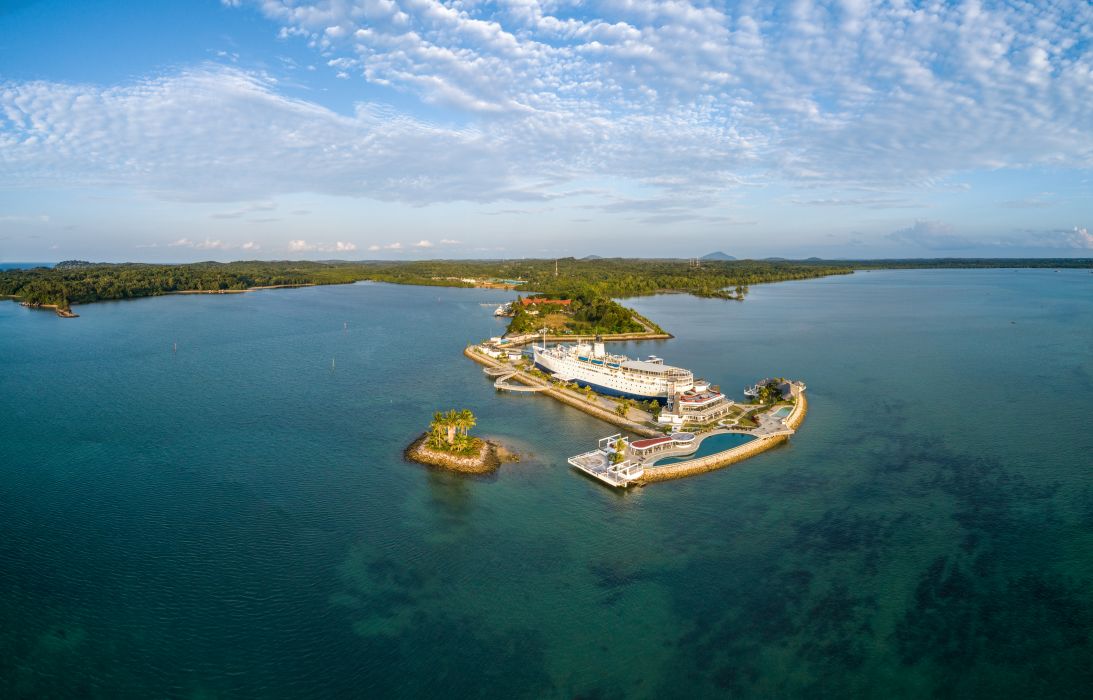
Over 15 years, Saw invested 23 million Singapore dollars (approximately $18 million USD) to reimagine the ship. The project wasn’t just a renovation—it was a reinvention. The ship, renamed Doulos Phos (“Servant of Light” in Greek), was towed to Batam, Indonesia, for refurbishment before being hauled onto a reclaimed anchor-shaped plot in Bintan’s resort-laden landscape in 2019.
Engineering a Land-Based Marvel
Relocating a 5,000-ton ship to dry land was no small feat. The Doulos Phos now rests on a 427-by-52-foot concrete platform, supported by piles driven deep into the South China Sea’s seabed. Major structural changes included removing fuel tanks and bulkheads to expand cabins, installing new plumbing and electrical systems, and adding elevators and fire escapes to meet building codes. Yet, Saw ensured every modification was reversible, preserving the ship’s potential to sail again—a nod to its builders’ enduring craftsmanship.
A Concrete Foundation
The ship’s new home, a custom-built concrete platform, anchors it firmly on land while maintaining its nautical charm. Guests can still feel the ship’s sway, with some jokingly reporting seasickness from peering through portholes at the waves.
Preserving Maritime Heritage
Despite its transformation, the ship retains relics of its past: a propeller shaft, six original lifeboats dangling from pulleys, and an untouched engine room open for tours. These elements keep the Doulos Phos steeped in history.
The Challenges of Restoration
Converting a century-old ship into a luxury hotel came with hurdles. Rust remains a relentless foe—Saw quips that painting from bow to stern is a never-ending cycle. The original cabins, cramped with double bunks for four, required extensive reconfiguration. New windows replaced tiny portholes, and 93 cabins now span multiple compartments, offering modern comfort while retaining nautical authenticity. The 2019 opening hit a snag with COVID-19 restrictions, delaying full operations until 2023, but Saw’s resolve never wavered.
Battling Rust
“The rust issues are always there, even on land,” Saw notes, likening maintenance to a Sisyphean task. Yet, his team’s diligent upkeep ensures the ship’s steel heart endures.
Adapting to Modern Standards
Transforming spartan cabins into luxurious suites meant installing modern amenities while navigating strict building regulations. Elevators and fire escapes were added, balancing safety with the ship’s historic character.
A Luxury Hotel with a Purpose
Today, the Doulos Phos is a unique retreat, blending maritime nostalgia with modern hospitality. Its 93 cabins, costing 1.7 to 3.8 million Indonesian rupiah ($105–$235 USD) per night, feature low-ceilinged passageways, heavy metal doors, and private balconies repurposed from sailors’ walkways. Guests, from families to history buffs, enjoy a ship-like experience—some even feel a playful “seasickness” gazing at the ocean. All profits fund Christian charities, fulfilling Saw’s mission-driven vision.
A Unique Guest Experience
The hotel’s authenticity is its draw. Circular portholes, sea-view balconies, and preserved artifacts like lifeboats create an immersive stay, distinct from typical resorts.
Funding a Greater Cause
Saw’s commitment shines through: operational profits support charitable causes, reflecting his belief that the ship, a “mass of steel,” gains meaning through its impact. His $1 salary symbolizes this selfless pursuit.
Why Bintan Island?
Bintan, known for its all-inclusive beach resorts, was the perfect landing spot. Its proximity to Singapore, a hub for affluent travelers, ensures a steady guest flow. The anchor-shaped reclaimed land adds a poetic touch, grounding the ship in a tourist-friendly locale. The island’s tropical allure complements the ship’s exotic appeal, making it a must-visit for those seeking unique stays.
A Strategic Location
Bintan’s resort-heavy economy and Singapore’s affluent travelers make it an ideal spot. The ship’s beachfront perch on reclaimed land enhances its allure as a destination.
A Tropical Escape
The island’s lush beaches and vibrant tourism scene amplify the hotel’s appeal, offering guests a blend of history and relaxation in a paradisiacal setting.
Comparing Doulos Phos to Other Ship-Turned-Hotels
The Doulos Phos isn’t alone in its reinvention. Other retired ships, like the Queen Mary in Long Beach, California, and the Queen Elizabeth II in Dubai, have also become hotels. Here’s how they stack up:
| Feature | Doulos Phos | Queen Mary | Queen Elizabeth II |
|---|---|---|---|
| Year Built | 1914 | 1936 | 1967 |
| Location | Bintan, Indonesia | Long Beach, USA | Dubai, UAE |
| Cost of Conversion | $18 million | Not publicly disclosed | Not publicly disclosed |
| Room Count | 93 | 347 | 215 |
| Unique Feature | Profits fund charities | Historic WWII troop carrier | Only floating hotel in Dubai |
| Nightly Rate | $105–$235 | $150–$400 | $200–$500 |
A Niche in Maritime Hospitality
Unlike the Queen Mary’s vast amenities or the Queen Elizabeth II’s floating status, the Doulos Phos stands out for its charitable mission and reversible modifications, preserving its seaworthy potential.
Pros and Cons of Staying at Doulos Phos
Pros:
- Unique historical experience with authentic maritime artifacts
- Beachfront location in tropical Bintan
- Supports Christian charitable causes
- Modern amenities like elevators and large windows
- Reversible modifications preserve the ship’s legacy
Cons:
- Ongoing rust maintenance may affect aesthetics
- Smaller room count compared to competitors
- Initial COVID-19 delays impacted early operations
- Niche appeal may not suit all travelers
- Higher-end rates ($235/night) for premium cabins
A Stay Like No Other
The pros highlight a one-of-a-kind stay with a meaningful purpose, though the cons suggest it’s best for those prioritizing history over conventional luxury.
People Also Ask (PAA)
What is the oldest passenger ship turned into a hotel?
The Doulos Phos, originally the SS Medina built in 1914, holds the record as the world’s oldest passenger ship converted into a hotel. Purchased by Eric Saw in 2010, it was transformed into a luxury hotel in Bintan, Indonesia, opening in 2019.
How much did it cost to convert the Doulos Phos into a hotel?
Eric Saw invested approximately 23 million Singapore dollars, or $18 million USD, over 15 years to convert the ship into a luxury hotel, including towing, refurbishment, and land reclamation costs.
Where is the Doulos Phos hotel located?
The Doulos Phos is located in Bintan, Indonesia, on a reclaimed anchor-shaped plot in the South China Sea, near Singapore’s affluent tourist market.
What are the room rates at the Doulos Phos hotel?
Nightly rates range from 1.7 to 3.8 million Indonesian rupiah, approximately $105 to $235 USD, depending on the cabin type and season.
Planning Your Visit
For those intrigued by maritime history or seeking a unique getaway, the Doulos Phos offers an unforgettable experience. Book through Doulos Phos The Ship Hotel’s official site for the best rates and packages. Ferries from Singapore to Bintan are frequent, with travel agencies like Bintan Resort Ferries offering seamless transfers. For budget-conscious travelers, consider off-peak seasons for lower rates, and check platforms like TripAdvisor for guest reviews and deals.
Getting There
Ferries from Singapore’s Tanah Merah Ferry Terminal to Bintan take about an hour, making the Doulos Phos accessible for weekend escapes or extended stays.
Best Booking Tools
Use Booking.com or Agoda for competitive rates and flexible cancellation policies. For exclusive offers, the hotel’s website often lists seasonal promotions.
A Legacy Preserved
Eric Saw’s $18 million gamble transformed a ship on the brink of destruction into a beacon of hospitality and charity. The Doulos Phos stands as a testament to human vision, blending history with modern comfort. Its cabins, once spartan, now welcome guests with warmth, while its profits uplift communities. As Saw muses, the ship could last another 111 years—its story, like its structure, endures, inviting travelers to step aboard and become part of its legacy.
A Mission Beyond Profit
Saw’s dedication ensures the ship’s earnings support meaningful causes, making every stay a contribution to a greater good. It’s a rare blend of luxury and purpose.
FAQ
How old is the Doulos Phos ship?
Built in 1914, the Doulos Phos is 111 years old, earning it the title of the world’s oldest passenger ship turned into a hotel.
Can the Doulos Phos still sail?
While currently a land-based hotel, Saw claims all modifications are reversible, meaning a future owner could theoretically return it to the sea.
What makes the Doulos Phos unique?
Its historical significance, preserved maritime artifacts, and charitable mission set it apart, offering guests a stay rooted in a century of seafaring legacy.
Is the Doulos Phos family-friendly?
Yes, the hotel caters to families, with spacious cabins and Bintan’s beachfront activities, though its niche historical appeal may best suit curious travelers.
How does the Doulos Phos compare to other Bintan hotels?
Unlike typical resorts, it offers a shipboard experience with historical charm and a charitable focus, though it has fewer rooms and higher rates than some competitors.